

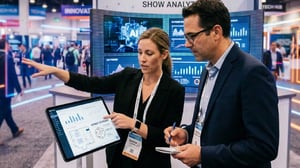


Key TakeawaysAI can speed up trade show exhibit ideation, but strong results start with a clear strategy built around business goals, priority audiences, and desired outcomes. By connecting strategy, attendee experience, and measurement, exhibitors can make smarter design decisions and continuously improve their trade show program.
|
HOW TO USE AI-GENERATED IDEAS, CREATE RELEVANT ATTENDEE EXPERIENCES AND TURN EVENT INSIGHTS INTO BETTER DECISIONS.
Last reviewed: October 25, 2026
Brian Lanning reviewed this article for factual accuracy, technical completeness, and alignment with current industry practices. With over 25 years in tradeshow marketing, Brian specializes in guiding clients through complex exhibit programs from concept to completion.
You can get a lot of exhibit ideas on the table quickly with AI. Explore a few creative directions, visualize a booth, and bring a detailed concept to the first planning meeting. That can give your team a useful place to start.
Before you get attached to a concept, though, make sure the strategy is in place. The design should reflect your business goals, audience priorities, and desired outcomes. Defining those first gives the creative process direction and your team a clear basis for evaluating the ideas AI helps generate.
Equally important is how that strategy carries through to the attendee experience and measurement plan. Who are you designing for? What do they need from the experience? And what do you want to learn from their visit?
A connected approach to strategy, experience, and learning helps your team work through those questions. Here are three rules to guide the process.
1. A Great Prompt Is Not a Great Brief
AI can help your team explore possibilities and make abstract ideas easier to discuss. A strategic brief gives that exploration purpose by establishing what the exhibit needs to accomplish.
Say an early concept includes a presentation theater, interactive product displays, a hospitality area, and several brand stories. There may be a good reason for each. The next conversation should establish which elements deserve the most attention and how they support your goals.
Agree on the priorities first.
Before committing to a visual direction, work through a few questions with your team:
-
What business outcome should this show support?
-
Which audiences are the priority, and what do they need from us?
-
What should attendees understand, feel, or do after the experience?
-
Which message should come through during a brief visit?
-
How should budget, footprint and reuse across shows influence the design?
These answers give everyone practical criteria for evaluating concepts. You can still discuss what you like about a design, while also asking how well it serves the people you want to reach.
For example, imagine you are launching a complex product. An early concept features a large presentation theater, but your priority buyers need to evaluate specific applications. That is a good reason to discuss the balance between presentation space, hands-on demonstrations, and one-to-one technical conversations.
Make room for judgment and prioritization.
Sales may want more meetings. Product teams may want more demonstrations. Marketing may have a new brand story to introduce. A useful brief brings those priorities together and establishes what leads.
AI can help organize that input and generate ideas. Your team and exhibit partner still need to assess the concepts for relevance, feasibility, and focus. That includes asking what to simplify or leave out.
We explore the value of that expertise in our article, Choose Your Exhibit Partner on Capabilities, Not a Speculative Design. It covers why strategic thinking and execution capabilities belong in the selection process alongside creative design.
AI can get you to an idea faster. Strategy helps you decide which ideas to develop.
2. The Attendee Journey Isn’t a Straight Line
On a floor plan, the ideal attendee journey can look simple: enter here, watch a presentation, explore a product, and speak with a representative.
Then the show opens, and people arrive with their own plans.
A first-time visitor may want a quick introduction. A technical evaluator may head straight to a demonstration. An existing customer may be looking for someone who can discuss a specific challenge. Each has a different reason to spend time with you.
Give visitors relevant choices.
Start by identifying what each priority audience wants to learn or accomplish. Then create clear options that help them get there. Depending on your objectives, those could include:
-
A concise overview for people discovering the brand.
-
Hands-on demonstrations for visitors exploring product capabilities.
-
Application-focused conversations for attendees evaluating a solution.
-
Meeting space for customers and prospects ready for a deeper discussion.
Think of these as different entry points into the experience. Someone might go directly into a technical conversation, explore independently, or come back later with a colleague. Your layout and content should make those choices easy to recognize.
Keep the experience connected.
A flexible journey still needs clear organization. Consistent messaging, recognizable engagement areas, and useful navigation help attendees understand what you offer and where to go next.
Staff help connect those options. A question as simple as “What are you hoping to explore today?” gives a team member a useful starting point. From there, they can guide the visitor toward the right content, demonstration, or colleague.
Our article on lessons from live brand activations explores how hands-on experiences, consistent messaging and authentic staff connections contribute to engagement. You can begin with a few well-planned choices, and a team prepared to help visitors find what matters to them.
3. A Dashboard Is Not a Strategy
Once the show ends, your team may have traffic counts, dwell time, content interactions, survey responses, and lead records to review. The useful question is: What can we learn from them?
A busy demonstration area might reflect strong interest, limited capacity, or both. A long visit could include a productive discussion, time spent waiting, or several different activities. Context helps you interpret the numbers.
Decide what you want to learn before the show.
Start with your objectives and identify the questions your team needs to answer. For example:
-
Product evaluation: Which demonstrations attracted priority buyers, and what questions did they ask?
-
Brand understanding: What did visitors take away, and where did they need more explanation?
-
Sales conversations: Did your team reach the right people and agree on relevant next steps?
-
Experience navigation: Could visitors find the content or conversations they wanted?
Then select the information that will help answer those questions. This gives each measurement a purpose and keeps data collection focused.
Our Custom Modular Experiences approach connects business objectives, exhibit design, activations, and measurement to support ongoing program improvement.
Turn findings into a specific next step.
Bring the team together after the show to compare expectations with what happened. Review the numbers alongside attendee comments, staff observations, and sales feedback.
Suppose a demonstration attracts plenty of participation but relatively few follow-up meetings. Look at who attended, how staff introduced the next step, and what information was captured. Those details can help you decide what to adjust.
Your next test might be a shorter demonstration focused on two priority applications or a clearer way to schedule a follow-up conversation.
Give the change a specific purpose so you can evaluate it at the next event.
Bring Strategy, Experience, and Learning Together.
The brief establishes your objectives and audience priorities. The exhibit turns those priorities into relevant experiences. Measurement helps your team evaluate the results and plan improvements.
Keeping those decisions connected gives everyone a shared direction, from the first concept discussion through post-show follow-up.
As you plan your next exhibit, start by agreeing on what the experience needs to accomplish. Use that direction to guide your AI-assisted exploration, the choices you offer attendees and the questions you want measurement to answer.
Contact us today for a free consultation!
