

.jpg?width=300&name=Get%20Lit%20Blog%20-%20Social_blog%201920x1080px-03%20(1).jpg)


Article SummaryBacklit trade show displays help exhibitors attract more attention, create stronger brand impact, and maintain consistent visibility regardless of venue lighting conditions. By combining vibrant illuminated graphics with long-term durability and reusability, backlit exhibits offer a powerful way to make your booth more memorable and effective on the show floor.
|
A trade show hall is a competitive environment. Dozens, hundreds, and sometimes thousands of exhibitors are all vying for the same few seconds of attendee attention. A backlit trade show display or backwall gives your booth a built-in advantage: stronger visibility, more vibrant branding, and a more premium look than an unlit graphic or one lit only with front-facing spotlights. Instead of relying on whatever ambient lighting the venue provides, your backwall becomes its own light source, a billboard doing its own work.
Here's why backlighting belongs in your next exhibit.
1. Visibility and Stopping Power
The first job of any booth is to get noticed. Backlit graphics stand out in a crowded hall, turning your display into a beacon down the aisle so attendees spot you earlier and from farther away.
Backlighting also performs consistently regardless of the room. Trade show halls are often dim, unevenly lit, or full of harsh overhead spots. A backlit graphic cuts through that inconsistency, keeping your key message readable from the moment doors open to the moment they close.
That consistency extends to legibility. Because the light comes evenly from behind the graphic, text and icons stay easy to read at a glance, which matters when attendees are scanning booths in seconds, not minutes. Unlike front lighting, which can create glare or uneven hot spots, backlighting delivers a clearer, more consistent message across the whole surface.
.jpg?width=500&height=400&name=Skyline-Exhibits-Booth-EMS2026-Backlit%20(1).jpg)
2. Brand Impact and Graphic Quality
Beyond visibility, backlighting elevates your brand. Dye-sublimated backlit fabrics appear richer and more dimensional when lit from behind: reds pop, blues deepen, and gradients render more smoothly than they would under front lighting.
That polish translates directly into brand recall. A high-resolution, illuminated graphic feels more memorable than a flat wall attendees walked past. Your exhibit becomes “the glowing booth with the great message” rather than just another backdrop.
There's also a perception shift. A backlit wall signals investment and quality, reading more like a permanent brand installation than a temporary sign clipped to pipe and drape. Front-lit setups can look good too, but the effect depends heavily on fixture placement and the room's ambient light. With backlighting, the “wow” factor is built into the structure itself.
3. Control Over Your Own Lighting (Not the Venue's)
One of the most practical advantages of backlighting is control. You're no longer at the mercy of the hall's overhead fluorescents or a neighboring booth's fixtures. You decide how bright, warm, or cool your primary brand surface looks.
LED edge- or perimeter-lighting inside the display frame distributes light uniformly across the graphic, reducing the shadowing and hot spots that come with floor lamps or clamp-on front lights. And because the frame and lighting system stay the same from show to show, you get a repeatable, predictable presentation everywhere you exhibit. Front lighting, by contrast, is inherently more variable: great spots at one show, a darker aisle at the next.
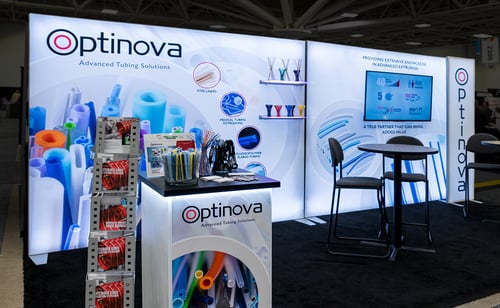
4. Practical Benefits: Cost, Durability, and Flexibility
Backlighting is also a smart long-term investment. Upfront cost runs higher than a non-lit wall, but LED backlit frames last for years, and updating your look often means replacing only the fabric graphic. Many exhibitors reuse the same hardware across multiple shows and campaigns, a strategy at the core of Skyline's custom modular approach to reconfigurable, reusable exhibit design.
LED systems are also energy efficient. They draw relatively little power, run cool, and typically work fine on standard booth circuits without added electrical complexity.
And modern backlit walls tend to be genuinely easy to use: modular, lightweight aluminum frames with silicone-edge graphics, often featuring tool-less assembly and cases built for easy shipping. Compared to separate front-lighting fixtures (which require positioning, aiming, and attachment hardware), a backlit frame is one integrated system instead of several moving parts.
5. Backlit vs. Front-Lit: When Each Makes Sense
Backlighting isn't the right call for every situation. The table below breaks down when each approach makes the most sense.
In practice, many exhibit programs land in the middle: a backlit backwall or tower for brand and messaging, paired with targeted front lighting for product shelves or demo zones. It's less about choosing one over the other and more about matching the lighting strategy to what you most need attendees to see.
Bring the Glow to Your Next Show
Whether you're outfitting an inline exhibit, a large custom island, or a portable display for a smaller footprint, backlighting is one of the most effective ways to make your brand the one attendees remember.
We've seen this firsthand. In a recent exhibit, we paired backlit displays with custom flooring, and the combination really popped on the show floor. A number of attendees commented on how the exhibit stood out from a distance, proof that the right lighting can do a lot of the heavy lifting before an attendee ever reaches your booth.
Browse our idea gallery for backlit booths or get in touch to talk through what backlighting could do for your next exhibit.
Contact us today for a free consultation!