

.jpg?width=300&name=Young%20Professionals%20with%20Digital%20Experiences%20at%20Trade%20Shows%20Blog%20-%20Social_blog%201920x1080px-03%201%20(1).jpg)
Article SummaryYoung professionals are increasingly drawn to trade show booths that prioritize interaction over passive presentations, making digital activations like touchscreens, kiosks, RFID, and gamification powerful tools for engagement in even smaller 10x20 or 20x20 exhibit spaces. By focusing on clear goals, concise interactive content, and staff training, exhibitors can create memorable experiences that generate stronger conversations, leads, and post-show advocacy.
|
Walk any busy trade show floor today and you will notice something: the booths drawing the biggest crowds are not the ones with the nicest banner walls. They are the ones where people are doing something. Touching a screen. Playing a game. Picking up an object that triggers a video. Laughing.
That is not a coincidence. According to CEIR research, 64% of young professionals engage in product activations and in-booth interactions — and 43% share positive feedback about hands-on experiences, compared to just 5% who share negative feedback. Young professionals, the fastest-growing segment of trade show attendees and an increasingly influential one at the purchase-decision table, do not want to be talked at. They want to participate.
For exhibitors in 10x20 or 20x20 island-style booths, that creates a real opportunity. You do not need a 40x40 footprint to deliver an experience worth remembering. You need the right technology, a clear strategy, and a willingness to think about your booth less like a display and more like an activation.
Think "Activation", not “Presentation”
The term gets thrown around, but it means something specific here. An activation is any element in your booth that invites a visitor to do something…not just look or listen but actively engage. It changes the relationship between your brand and the attendee from broadcast to conversation.
The problem with a lot of booth technology is that it is deployed passively. A touchscreen showing a PDF version of your brochure. A looping product video that nobody asked to watch. A kiosk with your company website on it. None of that is activation — it is just a screen.
Young professionals, particularly, will see through it. They can pull up your website on their phone in 10 seconds. They are not at the show for content they could find anywhere. They are there for the experience — and if your booth does not offer one, they will find one three aisles over.
The shift in how exhibitors are using touchscreens reflects this. Where early touchscreen deployments leaned on PowerPoints and PDF slides, today's most effective installations use animation, motion graphics, and branching storytelling that lets the attendee make choices and explore on their own terms. The content is curated, concise, and built around what the visitor gets out of it, not just what the brand wants to say. Our VP of Strategy refers to this as edutainment: being educated and entertained at the same time.
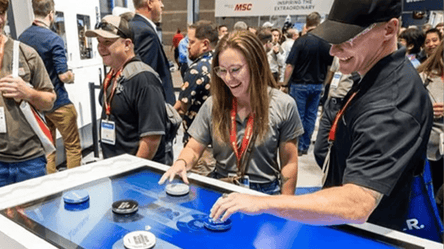
The Technology That Works in Smaller Spaces
Not every digital tool makes sense for a 10x20 or 20x20 island booth. LED video walls and immersive AR environments are impressive, but they require significant real estate and budget that does not always pencil out at that scale. The good news is that the most effective tools for engaging younger audiences do not require a massive footprint.
Touchscreens
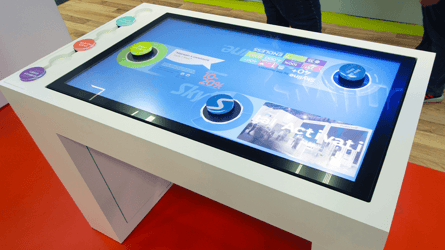
The touchscreen remains the most versatile activation option available. Mounted to a wall or set on a stand, a well-programmed touchscreen can serve as a product navigator, a gamification platform, a lead capture tool, and a brand storytelling device, sometimes all at once.
Placement matters. A screen at the back of the booth works well as a reward that you guide a qualified visitor toward after a conversation. A screen positioned at the front or side of the booth works as a draw, pulling people in from the aisle with motion and interactivity.
When the screen is not being used, a looping screensaver with animated brand visuals or a simple "Touch to Play" prompt keeps it working. Those small motion cues are often what catches someone's eye 20 feet away.
Content-wise, the rule is simple: less is more. Trade show attendees are moving fast and processing a lot. Long text blocks and dense product information will send them elsewhere. Keep the on-screen experience short, visually dynamic, and action oriented. Documents with heavy detail such as spec sheets and white papers, should be deliverable as a link sent directly, not required for reading in the booth.
Kiosks
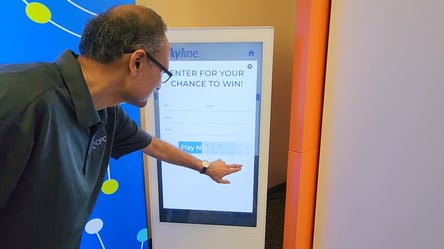
A kiosk functions differently from a wall-mounted screen, and the distinction is worth understanding. Where a touchscreen is often positioned inside the booth experience, a kiosk can be placed at the front edge, making it visible from the aisle, accessible without committing to walking fully inside.
That positioning makes it a traffic tool as much as an engagement tool. A visitor who stops at your kiosk is already a warmer lead than someone who walked past your banner. From there, your staff can step in, introduce themselves, and use whatever is happening on the screen as a conversation opener.
Kiosks are also effective for self-guided exploration when booth staff are tied up in other conversations. A visitor can browse product information, enter their contact details, or complete a brief survey without needing someone to walk them through it — which means you are capturing data even when you are stretched thin.
RFID
Radio-Frequency Identification (RFID) tends to surprise people who have not seen it used in a booth context. The basic mechanic is simple: physical objects embedded with RFID tags trigger content on a nearby screen when they are placed on or near a reader. But the experience for the visitor feels almost intuitive, even a little magical.
For smaller booths, RFID works well as a structured engagement journey. A visitor picks up a branded object, places it on the reader, and something happens: a video plays, a product profile appears, a quiz begins. It is tactile, it is memorable, and it naturally creates a moment for a staff member to step in and continue the conversation.
It also does not require much physical space, which makes it well-suited to a 10x20 configuration where every square foot has a job to do.
Gamification
Games work because they answer the visitor's most basic question: what is in it for me? A well-designed game gives someone a reason to engage that has nothing to do with being sold to and that changes the dynamic entirely.
The most effective booth games do more than entertain. A branded quiz that walks a participant through your product benefits as they answer questions educates without feeling like a presentation. A points-based challenge that rewards deeper exploration of your catalog gives people a reason to stay longer than planned.
The friction at entry needs to be minimal. Requiring a full contact form before someone can play is one of the most reliable ways to kill participation. Let visitors experience the game first. Then, at the end — when they are invested and want their results, prize, or digital takeaway — invite them to share their information. That sequencing matters.
Decisions That Will Make or Break Your Digital Activation
Start with one clear goal
The biggest mistake exhibitors make with digital technology is not choosing the wrong hardware — it is trying to accomplish too much with a single activation. Brand awareness, lead generation, product education, and post-show follow-up are all legitimate goals. They are just not all achievable through the same experience.
Pick the one that matters most for this show. Build your content around it. Measure it afterward. That focus will produce better results than a Swiss Army knife activation that does not do any one thing particularly well.
Budget for all four cost areas
Digital activations involve more line items than most exhibitors initially plan for. Going in with clear expectations on each of these helps avoid surprises:
-
Hardware rental & installation: the installation and physical screens, kiosks, or RFID readers
-
Software and content development: this varies widely depending on complexity; a simple branded quiz costs a fraction of a fully custom interactive product experience
-
Internet connectivity: required if your activation needs to send digital collateral in real time, pull live content, or integrate with external platforms; often not needed if you are simply collecting data to review after the show
-
On-site electricity: a consistent line item that is easy to forget until you are on-site
Train your staff before the show opens
The technology will not do the heavy lifting on its own. Booth staff need to understand what each activation is designed to accomplish, how to guide a hesitant visitor into engaging with it, and how to use what happens next as a natural lead-in to a real conversation.
Some visitors will approach a kiosk or touchscreen and then hang back — not sure if it is okay to touch, not wanting to commit to anything. A staff member who can read that hesitation, step over naturally, and say "Here, let me show you how it works" is the bridge between passive technology and an active conversation.
Design for the distracted visitor, not the ideal one
The person approaching your booth has been walking for two hours, has a tote bag full of swag, and is half-thinking about a meeting they have in 45 minutes. Design your activation for that person, not for someone who came specifically to learn about your product.
That means: obvious entry point, immediate payoff, no required reading before the experience begins, and a clear reason to stay. If you can deliver value in the first 15 seconds, you have earned the next five minutes.
The Bigger Picture
The CEIR data on young professional engagement is not what happens in the booth. It is about what happens afterward. Attendees who have genuinely positive hands-on experiences share that feedback — with colleagues, with managers, sometimes on social media. The booth moment extends beyond the show floor.
That is the case for investing in digital activations that actually work, as opposed to ones that check a box. A touchscreen that no one touches is not just a wasted spend — it is a missed moment with a visitor who might have become a customer, or at least an advocate. Done right, a 10x20 tradeshow booth with a well-executed digital activation can generate more meaningful conversations and more actionable leads than a 30x30 exhibit space full of static graphics.
Technology has caught up to ambition. Interactive touchscreens, RFID, gamification, and smart kiosk placements are all accessible at scale levels that make sense for mid-sized exhibitors — not just the brands with the biggest footprints on the floor. The question now is whether you are using them as activation engines, or just as expensive as wallpaper.
Contact us today for a free consultation!