

.jpg?width=300&name=Rent%20Buy%20Hybrid%20Blog%20-%20Social_blog%201920x1080px-03%20(1).jpg)


Article SummaryChoosing between renting, buying, or using a hybrid exhibit strategy should be based on your full-year trade show calendar, booth sizes, event frequency, and branding needs rather than upfront costs alone. Modern rental exhibits offer the same design quality and customization as purchased exhibits, making hybrid approaches increasingly popular for balancing flexibility, cost control, and brand consistency.
|
If you're staring down next year's show calendar and trying to decide whether to rent, buy, or do some combination of both, you're not alone. It's one of the most consequential, and most misunderstood decisions in any exhibit program. Too often it gets treated as a single, one-time choice, when it's really a full-year investment question that depends on how many shows you're doing, how big those booths are, and how much your brand needs to flex from one event to the next.
Rentals used to carry a reputation for wrinkled graphics and a booth that looked like every other one on the show floor. That reputation doesn't hold up anymore. Skyline's rental exhibits come from the same custom modular components, structural systems, and graphics production used for purchased exhibits, so the real difference between renting and buying is ownership, not quality.
When Does Renting Make Sense?
Rental has gone from a fallback option to the default strategy for a lot of marketing teams, particularly ones whose show calendar covers multiple regions, booth sizes, or a testing phase before a bigger investment. A few situations where renting tends to make sense:
-
You're testing a new show or format. Try an island layout or a new region before you commit capital to a booth you might outgrow.
-
Your calendar is busy and varied. A 10'x20' inline booth one month and a 20'x20' island exhibit the next are much easier to handle with rental components than with a single owned structure.
-
You're exhibiting from outside of the U.S. Renting locally can help you avoid the cost and shipping delays of sending owned assets overseas.
-
You want to scale up for a key show. If you already own a Skyline exhibit, you don't have to buy a second structure to go bigger for a flagship event or a second simultaneous show in another city. As covered in our piece on supplementing a large exhibit with rental, you can rent additional structure to add onto what you already own, scaling up for that one show without taking on the cost of owning that extra capacity outright.
-
You're on a tight timeline. Turnkey rental kits can ship in as little as five business days after artwork approval, which helps when an opportunity comes up late, or your planning window is short.
What's the Total Cost of Ownership for a Trade Show Exhibit?
Comparing a rental invoice to a purchase price only tells part of the story. Buying an exhibit is a capital expense with its own depreciation schedule, and the real cost of ownership shows up well after the initial build: storage between shows and the wear and tear that the owner absorbs over the life of the structure. Crating and freight apply either way, but a rental exhibit shifts storage and refurbishment to an event-based cost handled by the supplier, rather than an ongoing expense you carry year-round.
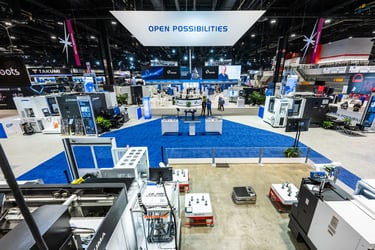
That gap compounds over time. When Okuma America, a longtime IMTS exhibitor with a large, multi-show program, moved to a custom modular strategy, they eliminated more than $60,000 in annual storage costs alone, without losing the commanding presence their booth is known for on the show floor. That's the kind of return that compounds every year a program stays modular, whether the components end up owned, rented, or both.
Most exhibitors don't pick one side and stay there. A hybrid approach, purchasing the structural walls and core branding elements that travel to every show while renting the oversized or footprint-specific pieces that only apply to one, lets you put capital into what gets reused and rent the parts that don't. It also frees up budget for the things that move the needle on the show floor, like high-impact graphics, interactive technology, and engagement experiences.
.png?width=444&height=250&name=Okuma-IMTS-2024-digital-displays%20(1).png)
Can a Rental Exhibit Still Be On Brand?
A rental shouldn't look like one. Skyline's rental inventory comes from the same custom modular systems and design language as purchased exhibits, which in practice means:
-
No visual downgrade. Custom graphics, brand colors, and finishes get applied the same way whether the structure is owned or rented.
-
Full reconfigurability. The same custom modular system can scale from a 10'x10' inline up to a 20'x20'+ island, so your brand stays consistent even as your footprint changes from show to show.
-
Digital and interactive add-ons. LED walls, touchscreens, and other digital activations layer onto rental structures the same way they would an owned exhibit.
-
Real design support. You still work with Skyline's design and project management team, not a self-serve catalog of generic kits, and every rental goes through pre-staging before it ships, so it arrives ready rather than arriving as a question mark.
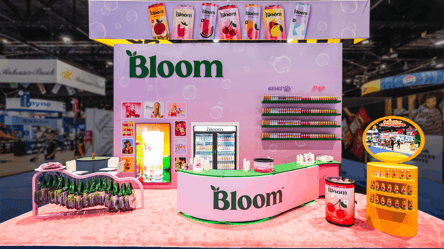
The design ceiling on rental is higher than most exhibitors assume. Nutrabolt's 30'x40' island booth, rented through Skyline for NACS 2025, gave equal, distinct presence to both C4 Energy and Bloom Nutrition in a single shared footprint, and went on to win a Bronze Stevie Award along with recognition from the American Business Awards and the MUSE Creative Awards. A custom rental program doesn't mean compromising on design; it can compete with, and beat, fully custom builds on pure design merit.
.png?width=400&height=250&name=C4-Energy-Drink-Rental-Booth%20(1).png)
Scaling From Inline to Island Without Starting Over
Booth size rarely stays constant across a show calendar. As covered in our piece on scaling from inline to island, a program running a string of inline shows and one larger island event doesn't need to buy an oversized, footprint-specific structure just for that one show. That's exactly the kind of expansion rental is built for: the purchase dollars are better spent on the walls and structural elements that travel to every show, while the pieces that only get used once or twice make more sense to rent. A custom modular system is engineered to be installed, dismantled, and reconfigured repeatedly, which is what makes scaling up or down for a single event manageable instead of a special project every time.
Supplementing a Large Exhibit with Rental
For exhibitors who've already invested in a booth structure, rental usually isn't about replacing that investment. It's about extending it, which is exactly the strategy behind Skyline's approach to supplementing a large exhibit with rental. If your program has a footprint or design you're happy with, rental lets you scale that presence up for a specific show, a second simultaneous event in another city, or a regional show that doesn't justify buying a whole second structure, without taking on the maintenance, storage, or pull-and-prep costs of owning that extra capacity outright. Skyline builds the same high-quality structures for both rentals and purchases, so scaling up for one event doesn't mean stepping down in quality for it.
When Ownership Still Wins
None of this means buying is the wrong call for everyone. If your brand is hitting the same structure at more than three shows a year, ownership can still be the more cost-efficient path over time. The asset can be capitalized and depreciated, which finance teams tend to appreciate. Companies with multiple business units also benefit from owning shared design elements that get reused across programs.
The tradeoff, as covered above, is adaptability. A structure built for one show doesn't always flex easily when a campaign shifts, a rebrand happens, or a new product line needs a different presentation. That's the core tension every exhibit program has to work through, and it's why the rent-vs-buy question is rarely all or nothing.
The Hybrid Model: What Most Programs Land On
Few programs are purely rental or purely owned. The pattern that shows up most often is a modular core, with a smaller share of owned, brand-critical elements supplemented by rental components for the pieces that only apply to a specific show. The owned pieces tend to be whatever carries the most brand equity: backlit logos, demo stations, proprietary display fixtures, often produced through Skyline's in-house wood, metal, and paint shops so a client's own materials or unique fabrication needs can be built directly into the structure.
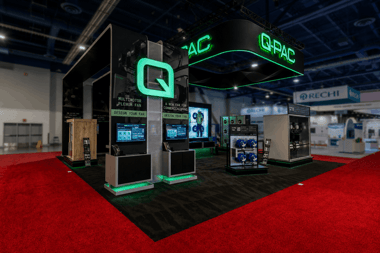
It's worth being precise about what the rented pieces are and aren't. Renting a structure doesn't mean it has to look different every time, and it doesn't mean it's locked into looking the same, either. A modular structure can be rented and reused in the same configuration show after show, or reconfigured into a different footprint entirely, depending on what a specific event calls for. Q-PAC's exhibit, detailed in our comparison of custom modular and fully custom exhibits, is a good illustration of how that pairs with custom elements: the fan configurator stations themselves are custom-fabricated pieces built specifically for their program, while the modular structure surrounding them, the part that's rented, is what makes reusing and reconfiguring around those custom elements possible from one show to the next. The point of a modular, rentable core isn't that it changes by default. It's that it can, without forcing you to buy a second exhibit to get there.
That flexibility only pays off if your brand standards are built to travel with it. Our piece on brand consistency across the show floor lays out a useful way to think about this: keep a fixed core of non-negotiables (logo treatment, color palette, core message, brand voice) and let everything else, including booth footprint and configuration, flex by show, audience, or region. Applied to a rent-vs-buy decision, that means the elements you own outright are usually the ones tied to that fixed core, while the rented structure around them is free to expand, shrink, or repeat depending on the calendar, without ever putting the brand itself at risk.
The result is a booth that reads as fully custom on the floor, while giving the program room to scale up, scale down, repeat, or reconfigure for a different footprint, all without shipping the same crate to every city on the calendar.
.png?width=450&height=253&name=Q-PAC_HVAC-booth-tradeshows%20(1).png)
Building Your Own Rent, Buy, or Hybrid Strategy
-
Start with your show calendar, not your budget. Booth sizes, frequency, and geography should drive the decision, not the other way around.
-
Decide what's worth owning. Identify the two or three brand elements that need to stay consistent everywhere, and plan those as owned assets.
-
Budget for graphics separately. In most rental programs, graphics are purchased while the structure itself is rented, so build that into your planning early.
-
Give large footprints a longer runway. Bigger island rentals need more lead time than small inline packages. Start those conversations well before you'd need to for a smaller booth.
-
Vet the vendor, not just the price. A rent-or-hybrid strategy only works if your partner has the inventory to back it up: a deep stock of custom modular components like curves, towers, and LED edge lighting, plus real in-house custom fabrication for the pieces no rental catalog covers. That combination is what lets you rent most of the booth and still execute the exhibit you actually designed.
-
Talk it through before you commit. The right mix depends on details specific to your program. Reach out to Skyline, or your exhibitor-appointed contractor, to walk through your calendar and figure out what's worth owning versus renting for your specific situation.
The Bottom Line
For most exhibiting programs, the honest answer to "rent, buy, or hybrid?" is: some of each. The exhibitors getting the most out of their programs aren't the ones who picked a side. They're the ones who mapped their real show calendar, were honest about how much their booth size and footprint change from event to event and built a mix that matches it. Treating rental and ownership as an either/or choice is usually costing you flexibility and design options you don't need to give up.
Contact us today for a free consultation!