

.jpg?width=300&name=Planning%20Program%20Blog%20-%20Social_blog%201920x1080px-03%20(1).jpg)
Article SummaryExhibitors who plan trade shows one at a time often fall into a reactive cycle that weakens brand consistency, strains budgets, and limits strategic decision-making. A program-level approach aligns objectives, budgets, and exhibit assets across the full schedule, enabling smarter investments, stronger brand presence, and better overall performance.
|
If your trade show strategy resets every time a new event appears on the calendar, you're not managing a program — you're starting over.
Many exhibitors approach trade shows one at a time. A new show gets added to the schedule, and the planning process starts from scratch: booth design, budget, logistics, goals. Then the show ends, and it starts again for the next one. It feels like progress, but it's actually a treadmill.
The exhibitors who show up the strongest aren't thinking show-by-show. They're thinking about their tradeshow program.
The Show-by-Show Trap
When you plan in isolation, every decision gets made without context. You don't know whether a big investment makes sense because you're not looking at the full year. You don't know whether an exhibit configuration works across your entire schedule. And you definitely don't know whether you'll still have budget left by Q4.
There's also the brand problem. Attendees travel the circuit and see your company at multiple shows throughout the year. If regional teams are running different exhibits, the brand becomes fragmented. What looks like flexibility from the inside looks like inconsistency from the outside.
Show-by-show planning tends to break down in two specific ways: brand consistency suffers because overlapping attendees encounter a different-looking company at different events, and budget visibility disappears because without the full picture, you can find yourself out of money with shows still on the calendar.
What Exhibit Programs Look Like
A program-level mindset starts with three things: your business objectives, your full show schedule, and your total budget. Before you make a single decision about booth design or exhibit structure, you need to see all three, side by side.
From there, the questions become much more strategic. If you attend shows across multiple footprint sizes, how should your assets work across all of them? There are a few paths to consider: buy a large exhibit and design it to break down for smaller footprints; invest in mid-size properties and rent supplemental space for flagship events; or keep your main exhibit optimized for your most important shows and use a separate portable solution for smaller ones. It’s important to consider all three options.
That last option often gets overlooked. A common scenario: a company attends two large, high-priority events and one smaller regional show in a 10x10 tradeshow booth. Instinctively, they want their 20x20 to break down and produce that 10x10. But the better question is whether designing around that constraint compromises the 20x20 — and whether a separate, on-brand portable unit would serve the program better overall.
It's also worth noting that venue height restrictions can affect this calculation significantly. Inline tradeshow booths come with height limitations that don't apply to island exhibits, which means a component that works beautifully in your large island footprint may not be usable in a smaller inline space. That doesn't mean components can't be reused across booth sizes — they often can, and when it's done well, it's one of the best ways to maximize your investment. But to do it effectively, you need to plan the full program with those constraints in mind from the start, not retrofit solutions after the fact.
The goal isn't one exhibit that does everything. It's the right combination of assets that keeps you on brand, maximizes your budget, and serves the full program.
➡️See our latest tradeshow booth designs
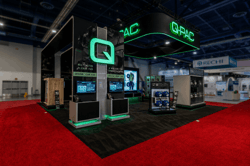
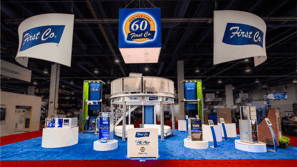
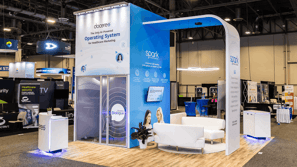
Budget the Whole Year, Not the Next Show
Trade show costs go far beyond the exhibit itself. Shipping, installation and dismantle, electrical, drayage, furniture and flooring rentals add up quickly, and they vary depending on the city and venue. Exhibiting in Vegas is a fundamentally different cost structure than exhibiting in many small, non-union cities. If you're not accounting for all of this across your entire schedule from the start, it's easy to get three-quarters of the way through the year, hit your budget ceiling, and still have three shows left.
Tight back-to-back show schedules create logistical risk as well. Shipping direct from one show to the next is common, but weather delays and timing issues can derail the whole chain. For certain events or times of year when schedules are compressed, renting can be a smarter way to build flexibility into the program and reduce that exposure.
Companies that don't plan at the program level tend to end up in one of a few bad spots: they run out of money, they cancel shows, or they go back to leadership asking for more budget. None of those are a great outcome and all of them are avoidable.
Start With What You Know, Then Build Out
Program planning doesn't have to be overwhelming. Start with the shows you're already committed to and the budget you have confirmed.
That's your foundation. Then layer in new opportunities, potential activations, and exploratory events as the picture becomes clearer.
For shows you're attending for the first time, renting is almost always the right call. It gives you the flexibility to test a show's value before committing to a larger investment, and it frees up budget to go bigger at the events where you already know you get results.
And that leads to the most important question: what does success look like at each show? Every event on your schedule should have an answer. Without it, you're just showing up, and you won't know which shows are worth doubling down on and which ones have become habit more than strategy.
From Executor to Strategic Partner
The way exhibit programs get managed has been shifting. Some teams default to "this is what we've always done": the same shows, the same footprint, the same approach year after year. Others are more open to questioning the lineup, trying new activations, and thinking about the program as a whole. The difference usually comes down to whether the program is being managed reactively or strategically.
What both groups increasingly want from their exhibit partner is strategic input, not just execution. They want someone who can look at the full program, spot what's working and what isn't, and bring innovative ideas to the table, even if not every idea gets implemented.
Conversations should not only cover booth structure but should also touch on engagement strategy, traffic flow, or what draws people in.
The Real Strategic Question
Here's a harder question than "how should we design our booth?": Why are we going to this show at all?
Many companies attend events out of habit. They've always done it, so they keep doing it. A program-level view forces that question into the open. It gives you the data to see which shows are performing and which ones have become legacy commitments that no one has stopped to question.
The right answer for many companies isn't to attend more shows. It's to attend fewer, with a bigger presence and a sharper strategy at each one. Pause a low-performing event. Double your investment at a strong one. Try a new activation while staying within budget. All of those moves are only visible when you're looking at the full picture.
Show-by-show planning, by definition, prevents it.
Contact us today for a free consultation!