

.jpg?width=300&name=Trade%20Show%20Sampling%20Blog%20-%20Social_blog%201920x1080px-03%20(1).jpg)
Article SummaryFree sampling at trade shows works not because of the product itself, but because of psychological effects like the “zero price effect” and reciprocity, which increase engagement and buying intent. When paired with a clear strategy, immersive booth design, and proper follow-up, sampling becomes a powerful driver of meaningful conversations and sales outcomes.
|
Ask any trade show exhibitor what drives booth engagement, and giveaways or sampling usually come up. It might be a food brand offering bites and sips to passing buyers, a wellness brand putting full-size products in the hands of key prospects, or a bakery that has turned its booth into a café. When it works, it works remarkably well. When it does not, it can feel like an expensive giveaway with nothing to show for it.
The difference is usually not the product. It is the strategy — and the psychology underneath it.
Why “Free” Changes How People Think and Buy
Duke University behavioral economist Dan Ariely and his colleagues identified what they call the “zero price effect”: when something carries a price of zero, people respond to it in ways that have little to do with the item’s actual value. In a well-known experiment, participants were offered a choice between a free Hershey’s Kiss and a premium Lindt truffle for just $0.13. More than twice as many chose the free Kiss, even though the truffle was objectively the better product at a negligible price. When researchers added a single cent to the Kiss, the results reversed completely. ¹
It is not that people are irrational. It is that “free” activates a different part of decision-making. People stop comparing options and start responding to feelings. As Ariely explains, when something is free, people simply do not see a downside.
There is a second force at work alongside this: reciprocity. When someone receives something for free, they feel a genuine, if subtle, impulse to give something back. At a trade show booth, that something is time, attention, and often a badge scan. As Ariely puts it, a free sample makes someone “feel obligated to some degree, [making] it more likely you buy the full package.” That impulse is one of the most useful things an exhibitor can understand.
What the Sampling Research Actually Shows
The data on in-store sampling gives a clear picture of what is possible:
-
A 65-week study by Marsh Supermarkets found that 68% of samplers were persuaded to buy a product after trying a free sample, with 83% saying sampling improved their overall shopping experience. ²
-
When Ziploc sampled a new space bag at Costco, it saw a 156% sales increase.
-
Brands collectively invest about $2 billion per year in free sampling - a number that reflects consistent, measurable returns.
One finding from the research tends to surprise people. A study in the “Journal of Retailing”, led by researchers at Brigham Young University, the University of Wisconsin-Madison, and Singapore Management University, found that sampling produces what they call a “category expansion effect.” A sampling event for one brand raised average sales for other brands in the same category that were not part of the event at all. ³ Sampling does not just move product. It creates a buying state of mind.
That matters on the trade show floor more than anywhere else. The people walking through the grocery or foodservice industry show are not wandering past — they registered, traveled, and showed up specifically to find new products and make buying decisions. A buyer persuaded in your booth does not make a one-time purchase. They commit shelf space.
.jpg?width=444&height=250&name=Trade%20Show%20Sampling%20Blog%20-%20Social_blog%201920x1080px-03%20(1).jpg)
How Café Valley Bakery Built a Booth Around the Sample
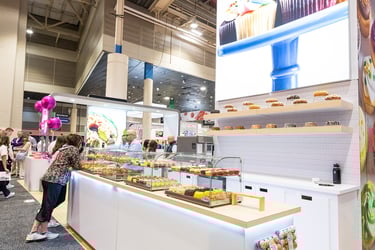
Café Valley Bakery had a packed agenda at IDDBA 2025. They were not launching one new thing — they were launching three: Barbie™ Cakes, Girl Scout™ Bundt Cakes, and an entirely new brand identity with updated logo and packaging. Each one would have been a full show strategy on its own. Their answer was to build a booth that functioned as an actual bakery. A working espresso machine ran throughout the show, filling the space with the smell of fresh coffee. Comfortable seating gave buyers a reason to stay rather than drift. Sampling was not a side activity — it was the entry point for every conversation.
The merchandising went further than most exhibitors' attempt. Instead of a shelf of products, Café Valley created distinct display settings: table vignettes that looked like a café, counter setups that read as grab-and-go spots, retail shelving that let grocery buyers see exactly how products would sit in their own stores. The bright pink backlit Barbie™ Cakes display stopped people in the aisle. Everything else gave them a reason to linger and picture the product working in their own business.
Buyers sat down, had coffee and cake, and talked, which is how tradeshow conversations become purchase orders.
.png?width=350&height=58&name=Cafe-Valley-Bakery-Case-Study-Button%20(1).png)
How Bloom Nutrition Used Sampling to Make an Impression at the NACS Show
At the NACS Show (convenience and fuel retailing’s premier industry event), Bloom Nutrition came to the show with a clear strategy: put the product in people’s hands and let it speak for itself. Sampling was central to how they showed up.
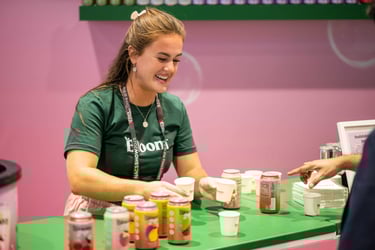
Bloom offered full-size cans of their energy and pop drinks, and smaller tastings to attendees exploring the booth, so everyone who walked in had a direct experience with the product — not just a look at the packaging. That is a meaningful distinction. Asking a buyer to imagine what something tastes like is vastly different from letting them taste it for themselves.
What made it land was that the sampling did not exist in isolation. The booth was built around Bloom’s brand identity — bold pink design, a custom bar, tote bag displays, and details that came together to create a coherent point of view. The staff matched that energy; they were genuinely enthusiastic about the brand and the product, not just managing a table. When everything in the booth is saying the same thing, the sample becomes part of a larger story rather than a standalone offer.
Buyers at a show like NACS are not just evaluating whether a product tastes good. They are deciding whether a brand belongs in their stores and whether it can connect with their customers. Bloom gave them a concrete answer to both questions — through experience, not just conversation.
.png?width=350&height=58&name=Bloom-Nutrition-Case-Study-Button%20(1).png)
Putting It Into Practice: Trade Show Sampling Strategy That Works
-
Start with a goal, not a product. The most effective sampling strategies are built backward from a specific outcome — a number of qualified leads, a trial with a defined buyer segment, or an introduction into a new channel. The sample serves that goal. Without one, you are just giving things away.
-
Lead with the sample, follow with the conversation. Do not make the pitch a prerequisite. Let the experience happen first (product in hand, taste on the palate) and then engage. People who have received something from you are already warmer than a cold approach will ever produce.
-
Match your environment to your product. Café Valley smelled like a bakery. Bloom looked like the brand. The booth environment either reinforces what the sample is communicating, or it undermines it. There is no neutral.
-
Let buyers picture the product in their world. Show it how they would use it - on a retail shelf, at a coffee counter, in a grab-and-go setting. A sample that helps a buyer visualize placement is doing sales work that a brochure simply cannot.
-
Make sure your people match your brand. Staff who are genuinely excited about a product read differently than staff who are going through motions. Buyers notice. Bloom’s booth worked partly because the energy in the room matched the brand's.
-
Capture the lead at the moment of exchange. A sample without a follow-up mechanism is a sunk cost. Badge scanning, QR codes, or a quick tablet sign-up — whatever the system, it needs to be part of the sampling interaction, not an afterthought.
-
Close the loop after the show. Reference the sample in your follow-up outreach. It grounds the conversation in something real, reminds the buyer of a positive experience, and makes your message feel like a continuation rather than a cold start.
Trade Show Sampling Is Not Just a CPG Strategy
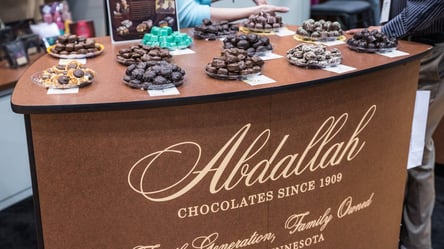
It is worth saying clearly: the principles here apply beyond food and beverage. Any exhibitor whose product can be touched, tried, or experienced — equipment, materials, software, devices, personal care — can put the zero-price effect and reciprocity to work. The specific execution changes. Underlying psychology does not.
What makes trade shows particularly well-suited to sampling is the audience. These are buyers who came to evaluate, who are in a decision-making frame of mind, and who will speak with dozens of vendors. A sample that creates an authentic experience is one of the most reliable ways to be the booth they remember — and follow up with.
The Case for Investing in Sampling at Your Next Show
Free does not just feel good to the person receiving it. It changes the relationship between a brand and a buyer in a way that is difficult to replicate through any other channel. The research backs it up. The brands doing it well — Café Valley, Bloom, and many others on show floors every year — prove it in practice.
A thoughtful sampling strategy, anchored in a clear goal and supported by a booth built around the experience, is one of the more reliable investments an exhibitor can make. Not because it is a trick, but because it works with human nature rather than against it.
Contact us today for a free consultation!
**Sources**
1. Shampanier, K., Mazar, N., & Ariely, D. (2007). Zero as a Special Price: The True Value of Free Products. *Marketing Science*, 26(6), 742–757.
1. Burke, R. R. (1993). Marsh Supermarkets, Inc. (A): The Marsh Super Study. Harvard Business School Case 594-042.
1. Chandukala, S. R., Dotson, J. P., & Liu, Q. (2017). An Assessment of When, Where and Under What Conditions In-Store Sampling is Most Effective. *Journal of Retailing*, 93(4). DOI: 10.1016/j.jretai.2017.07.002