

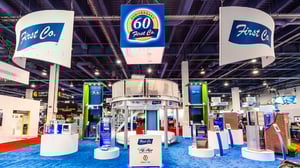
Article SummaryUpgrading to an island booth requires strategic planning beyond booth size alone, including total program costs, show-city labor differences, floor placement, and long-term scalability. The article emphasizes that a well-planned island exhibit can be a powerful investment when aligned with clear goals, realistic budgeting, and phased growth planning.
|
I was on a call recently with a client I have partnered with for a couple of years. She had been in a 10×10 portable tradeshow display, then moved up to a 10×20, and now her team was ready for the next chapter: an island booth. They were excited, energized, and already picturing the hanging sign.
By the end of our conversation, we had mapped out a full picture including total program costs, floor placement strategy, city-by-city labor realities, and a phased growth plan her team could align around. She left the call more confident than when she started.
That is exactly the kind of planning conversation every exhibitor deserves. Whether an island booth is the right move for you right now or a step you are building toward, here is a framework to help you and your team make the decision with clarity and confidence.
"Out of all the conversations with exhibit houses I've had, you're the only one who has brought this up."
— Marketing Director, after our booth planning call
Start With the Why and Get Specific
Island booths are impressive. The hanging sign, 360-degree access, and larger footprint signal your brand has arrived and creates the kind of presence that draws people in from across the floor. For many companies, an island booth is exactly the right move.
The key is getting specific about what you want it to accomplish. Is it more of an activation space? Room for product demos? Capacity for your staff to work more leads simultaneously? A stronger visual landmark on a busy show floor?
Getting clear on the "why" helps ensure the booth you design — size, layout, features, and activations — is built to deliver on those goals. It also helps your team prioritize where to invest within your budget for maximum impact.
Plan for the Full Program Cost, Not Just the Booth
One of the most valuable things you can do early in the planning process is flesh out the total program cost. The booth structure itself is just one piece of a larger investment, and understanding the full picture sets your team up to budget confidently and avoid surprises down the road.
Here is what to factor into your full program planning:
-
Build quality: Island booths typically run $250–$300 per square foot to execute well. A beautifully built 20×20 (400 sq ft) island is a significant investment — and worth planning for from the start.
-
Rigging: A hanging sign is one of the most powerful visual elements of an island. Budget $6,000–$14,000+ per show for rigging, depending on the city and venue.
-
I&D (Installation & Dismantle): Labor costs scale with footprint. One of my clients paid $8,000 for I&D in Dallas — and nearly $20,000 for the same program in Anaheim the following year. Both were great shows; the difference was union labor rules.
-
Show services: Carpet, electricity, freight, and other services all increase with square footage.
-
Rental vs. purchase: If you are renting, factor in the cost across all shows in your annual program. If you are purchasing, plan for amortization and long-term flexibility.
The goal is not to scale back your vision — it is to fund it properly. When you know the complete picture going in, you can make the right decisions about booth size, features, and phasing.
Pro tip: Walk the total program cost — booth, rigging, I&D, tradeshow services, and freight — before finalizing your structure and features. It helps you design with confidence.
Factor in the City — Your Show Schedule Affects Your Strategy
This is one of the most valuable planning considerations, and one I raise in almost every strategic conversation: not all shows cost the same to execute, even at the same square footage.
Union labor rules, local labor rates, and venue-specific requirements can swing your I&D costs significantly from city to city. If your show rotates between markets — say, Dallas one year and Las Vegas or Anaheim the next — it is worth knowing that difference going in so you can plan accordingly. In addition to the venue location, fees vary show to show because each show negotiates fees with the general contractor.
Some clients choose to use their island for shows in lower-cost cities and exhibit with a well-branded inline in higher-cost union markets.
Others build the island program with city costs fully factored into their annual budget. Either approach can work beautifully — it just comes down to your goals and your overall program spend.
Knowing your show rotation history helps us design a program that's both impactful and sustainable year over year.
Think Beyond the Booth — Floor Placement and Phased Growth Matter
Two more factors that often get overlooked until it is too late: where your booth lives on the floor, and how your investment grows with you over time.
Floor placement matters enormously. A prime corner, a main aisle, or a spot near a high-traffic anchor exhibitor can amplify the impact of any booth — island or inline. When we plan together, we think about placement strategy alongside booth design, so your presence works from every angle.
Phased growth is another area where a little upfront thinking pays off significantly. If you are planning to grow into a larger island footprint in the next few years, we can design your current booth with that future state in mind. That might mean a modular structure that reconfigures and expands, or an inline built on a skeleton that grows into an island — so your investment compounds rather than being replaced.
My client loved this approach. Rather than feeling like she had to choose between now and later, she saw a clear path that worked for both.
"Let's build your foundation strategically — so we're growing into your vision, not starting over every time."
— How I approach every booth planning conversation
Your Island Booth Planning Checklist
Whether you are ready to move forward now or building toward it, here are the key questions to work through with your team and your exhibit partner:
-
What are our primary goals for upgrading — more space, more presence, more activations, or all of the above?
-
What cities will our shows rotate through, and how does that affect labor and logistics?
-
What floor placement options are available, and how do we maximize traffic to our space?
-
Are we purchasing or renting a tradeshow booth — and which makes the most sense for our show schedule?
-
Can our booth be designed to scale, so our investment grows with our program over time?
-
What pre-show and on-floor engagement strategy will make the most of our new footprint?
The Bottom Line
Upgrading to an island booth is an exciting milestone — and with the right planning, it can be one of the most impactful investments your brand makes in its trade show program.
Every company's situation is different: your show schedule, your goals, your budget, your timeline. The best decision is the one that is right for you — and that is exactly what these conversations are designed to help figure out together.
If you are thinking through your next booth move, I would love to be part of that conversation. Let us map out the full picture and build a plan that works for where you are now and where you are headed.
Contact us today for a free consultation!